Showing posts with label ASA. Show all posts

September 09, 2015

The United Nations and Cannabis: Evolving Policy to meet increasing demands for Medical Marijuana Patients Globally

In 1961, Representatives from 185 Nation States convened and signed an International Treaty designed to control and regulate the production and use of several drugs (mainly Narcotics) considered to have scientific or medicinal value and prohibit the use of others considered addictive and harmful to society. The United Nations Convention on Narcotic Drugs has served as the basis for standardization of National drug control laws since. The United States enacted the Controlled Substances Act of 1970 to fulfill treaty obligations.

At the time the treaty was executed, two regulatory agencies were assigned to move specified narcotic drugs through the four stages of schedules, The Commission on Narcotic Drugs (CND) and the World Health Organization (WHO). The International Narcotics Control Board (INCB) and the United Nations Office on Drugs and Crime (UNODC) were commissioned to serve as administrators and compliance monitors. 


Countries Party to the UN Conventions: Green
Non Parties: Red
Treaties Do Not Apply: Gold
Inclusion of a controlled substance in the Single Convention on Narcotic Drugs depends on its agreed placement in the scheduling system. Where a drug lands in the International Control Framework determines the type and intensity of controls. Currently Cannabis is scheduled as one of the most dangerous to society next to Heroin, Ecstasy, LSD, Benzodiazepines, GHB and Cocaine. Recent independent studies by the Global Commission on Drug Policy recommend Cannabis be moved to a low risk category.


Adjusting where Cannabis is scheduled in the International Framework is not complicated. The UN Conventions on Narcotic Drugs of 1961, amendments in 1971 and the Convention on Psychotropic Substances of 1972 all contain provisional scheduling measures available to initiate in response to urgent problems.

Voter approved initiatives in the United States in Colorado, Washington, Oregon, Alaska and Washington DC establishing recreational markets moves outside conformity to the UN Drug Conventions because the nature of the documents limits use of controlled substances to medical and scientific purposes only. Advances in Medical Research and changes in Public Opinion creates an environment which necessitates immediate change. 


Congress moved to clarify the US Government's position on the UN Drug Convention in October 2014 when Bill Brownsfield, The Assistant Secretary of State for Drugs and Law Enforcement at a press conference clarified. He outlined to members of the media how US Policy is centered around four pillars of thought: 1) Respect the integrity of the UN Drug Conventions. 2) Accept flexible interpretation of UN Drug Conventions with regards to how Nation States have changed since 1961. The Conventions should be updated to reflect current culture. 3) Tolerance of differing perspectives and enforcement methods of each Nation State. 4) No matter the difference, each Nation State works to combat criminal organizations.

Yury Fedotov, Executive Director of United Nations Office on Drugs and Crimes issued a statement expressing concerns new US laws are not compatible with current conventions. 
Congress responds in January 2015 when Senators Dianne Feinstein (D-CA) and Charles Grassley (R-Iowa) call for the Obama Administration to address the disparity between US Policy and the boundaries necessary to conform to the standards laid out in the UN Drug Accord. Concerned about protecting the United State's long standing position as leader in the "War on Drugs", these Senators requested the Administration to account for remarks sending the message of tolerance for illegal drugs. (AKA Ogden Memos) The Senators also pointed out how recreational laws deviate from US commitments to confine production of cannabis to research and medical purposes only. Since the Senators letter to then Attorney General Eric Holder, was delivered, a new Attorney General has been assigned and the issue is still under review. 

Reforms are necessary as International Trade is already happening between Nation States. Jamaica is setting up small farmers to export cannabis products such as infused lotions and body oils to Countries like Canada already set up to import these goods. Canadian Company FLOR whose Shareholders are mostly Jamaicans living in Canada is currently laying the groundwork for developing a supply industry. In addition, A Bob Marley Brand of such products has been announced to be available late 2015.  Increasingly, Nation States are moving to regulate Cannabis use for both recreational and medical use. Countries like Germany, The Netherlands, Uruguay and Canada have established medical marijuana programs, while countries like Costa Rica are moving to establish similar programs through legislative action now. 


Recently, at a Medical Cannabis and Cannabinoids Conference held in Prague, former deputy secretary of the INCB, Pavel Pachta told attendees the WHO would need to update their stance on Medical Marijuana to match current scientific findings soon. Many UN Representatives believing the current drug control system to be a failure are urging UN drug agencies to replace prohibition of Marijuana with legal regulation. Non Governmental Organizations working to reform International Drug Policy weighed in on the issue in a letter published through StopTheDrugWar.com. The letter represented more then 100 agencies and sited human rights violations as an immediate need for reform in global drug policy. 


Convention may shift April 2016, during the United Nations Special Sessions on World Drug Problems (UNGASS 2016) where members of the international community will present recommended amendments based on shifting trends in current Nation societies. Although some Nation States still wish to use corporal punishment including the death penalty for drug related charges, most nations are relaxing drug user laws, allocating resources to prosecute manufacturers and traffickers over users. Many of these Nations choose harm reduction policies meant to reduce incarceration over more stringent prison terms. Attendees expect contention between the Nations with hard line policies like Russia, China and more liberal countries like Uruguay and the US.


In March 2015, an International Coalition of Medical Cannabis Patients from 13 Countries led by Americans for Safe Access delivered a declaration urging the 2016 UN General Assembly Special Session on Drugs to either reschedule Cannabis to a less restrictive category or remove the plant from the schedule all together. Coalition member countries include Bulgaria, Canada, Czech Republic, Estonia, France, Israel, Italy, Latvia, Poland, Slovenia, Spain, United Kingdom, and United States.

"Current international policy makes it extremely difficult for many countries to establish laws that will meet the needs of their citizens," said IMCPC co-founder, ASA Executive Director, and longtime medical cannabis patient Steph Sherer. "The International Medical Cannabis Patient Coalition is uniting patient organizations as a common voice in the effort to change these policies."


Considering the International Commerce already being established for Cannabis, changes need to be made if Nation States are able to meet the needs of their Citizens. All eyes will be on the UN Special Committee in 2016. 


Research Links: 

1961 United Nations Single Convention on Narcotic Drugs Wiki
United Nations Drug Control: Scheduling in the International Drug Control System
U.S. states' pot legalization not in line with international law: U.N. agency
Bob Marley: The First Global Weed Brand
Jamaican Small Farmers included in the Medical Marijuana Industry
Canadian Company Taps into Jamaican Medical Marijuana Industry
Legality of Cannabis by Country Wiki
United Nations Convention on Illicit Traffic in Narcotic Drugs and Psychotropic Substances
Huffington Post It's Time For The UN To Reform Its Global Drug Policies, Human Rights Groups Say
Groups from Thirteen Countries Form New "International Medical Cannabis Patient Coalition" to Reform UN Policy

March 07, 2012

Cypress Hill and Guerilla Union bring out the masses for a peaceable march for Safe Access

Hundreds of people gathered today to stand in solidarity with B Real of Cypress Hill, Guerilla Union, Americans for Safe Access and The Medicine and the Music Project at Los Angeles City Hall for a peaceful protest and march for safe access. The protest comes in response to the recent Federal crack down and a proposed ban on medical marijuana in Los Angeles and just before the Smokeout Festival, a celebration of music and culture happening Saturday, March 3 in San Bernardino, CA.


B-Real and Guerilla Union have always considered SmokeOut Festival more than a showcase of musical talent. It's a movement of individuals supportive of decriminalization. "The artists’ have the ability to reach and educate their fans and followers in their respective communities including hip-hop, rock, Latin music or dance. It’s important we employ the collective voice of the music community and bring it to the medical marijuana debate. The SmokeOut for Safe Access rally serves as another podium and another step we need to take to further our success." explains B-Real. "Bringing people together to protest denying save access to medical cannabis patients is a part of the event's greater purpose, to bring about reform of current failed drug war policies and protect patients and businesses in California who voted to establish an industry here."

Don Duncan of American for Safe Access
Teaming up with Don Duncan of Americans for Safe Access and The Medicine and Music Project made sense for this political Rally. Teams of safety monitors and peace keepers were on hand to assure participants were non-violent and respectful of law enforcement officers. Guerilla Union provides signs exclaiming "Marijuana is Medicine" and demanding the reclassification of cannabis as a schedule I drug with no recognized medicinal value.

Don Duncan took a moment to speak with me for Marijuana.inc TV about some of American's for Safe Access's current projects and what is happening on a Federal Level. ASA is involved in 2 lawsuits against the Federal Government in an effort to reschedule cannabis from a Schedule 1 substance. More information can be found here, on the Americans for Safe Access website. Keep an eye on Marijuana.inc TV for full coverage. Read the official press release from Americans for Safe Access on their media site.

B-Real, Tommy Chong and Supernatural
Many artists joined activists, attorneys and patients in the March including Tommy Chong, Attorney Bruce Margolin and Daddy X of the Cottonmouth Kings. I had a moment to March with Daddy-X and expressed my gratitude for artists willing to stand with the patients on medical marijuana. Daddy-X knows the power of the voice of the people and hopes to encourage all of his fans to get involved in the political process.

Tommy Chong was well received by the crowd. I heard one fan exclaim, "Thanks for taking one for the team, Tommy!' just upon his arrival, a reference to Tommy's recent time served for selling bongs on the Internet. Tommy served 9 month in Federal Prison for Operation PipeDream, a campaign deployed over 2,000 law enforcement officers costing over $12,000,000. Read more here.

Criminal Defense Attorney Bruce Margolin
Attorney Bruce Margolin, a Los Angeles criminal defense attorney and Director of the Los Angeles Chapter of NORML was on hand to speak to the crowd about the importance of reforming corrosive cannabis prohibition laws. His em impassioned speech was both inspiring and educational, full of praise for everyone who participated for exercising their constitutional right to peaceably assemble. Bruce has represented several high profile clients including the infamous Timothy Leary for everything from marijuana to murder and has spearheaded efforts to regulate marijuana in California. Bruce continues work from his offices in Los Angeles.


The Hemps pose with the 420 Nurses
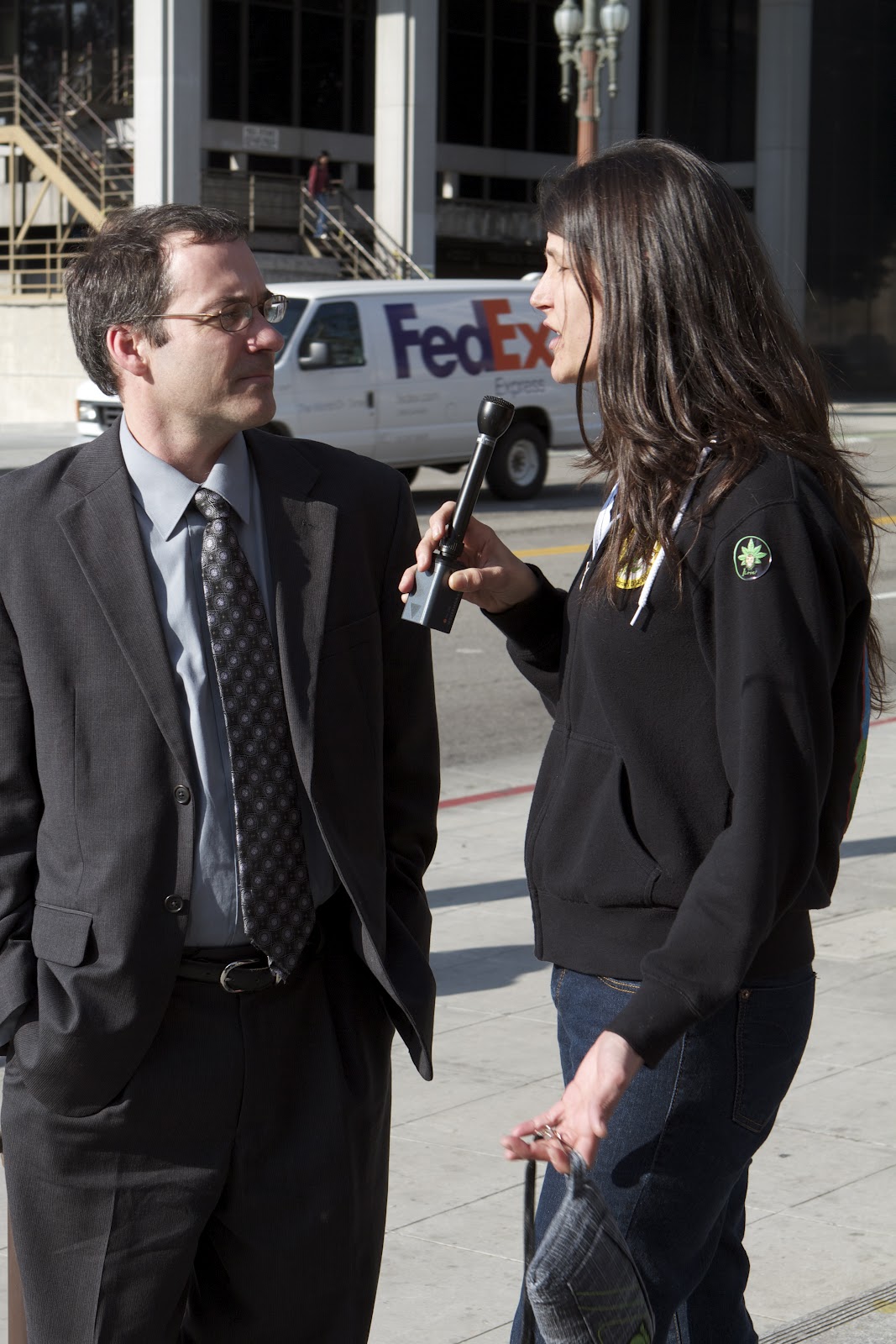
Henry Hemp and Mrs. Hemp conducted on the street interviews with attendees asking what inspired them to come out for SmokeOut for Safe Access. Some came to support their favorite artists, others represented business leaders and patients making their voices heard in the wake of fierce attacks from the Federal Drug Enforcement Agency in recent months. Many were concerned about their constitutional rights and brought signs demanding the government reschedule cannabis. The steps of Los Angeles City Hall became a sea of signs provided by Guerilla Union and creative pieces made and carried by a very determined crowd. Medical Marijuana is a recognized part of the culture in Los Angeles, confirmed by the diversity of those willing to take time on a work day to come out and stand up against a government refusing to accept cannabis as a medicine.

Comedienne Tere Joyce
Comedian Tere Joyce conducted a live interview with Russ Bellville of the NORML Daily Stash so NORML listeners were able to be a part of the march even if only vicariously. Check out the report on NORML Daily Stash Live show website.

At the end of the March, protestors lingered around a drum circle and networked with each other before dispersing without incident. Law enforcement officers were on hand, but very respectful of the crowd who assembled. As Tere pointed out in her NORML Daily Stash news report, the cops seemed to be OK with marijuana protestors considering the recent treatment of the Occupy movement evacuated just weeks before the event. The mood was definitely mellow. 

Full photo coverage can be found on Facebook here.