Direct Democracy, or pure democracy exists where citizens write policy initiatives themselves. If activist groups collect enough signatures in the allotted time, the initiative makes it to the ballot. If voters approve the initiative, it becomes law. In representative democracy States, citizens vote for representatives who then write and implement policy based on the best interests of the citizens of that State. Currently, in the United States, California, Oregon, Colorado, Michigan, Arizona, North Dakota and Montana are direct democracy States and have been able to establish Cannabis regulation through direct voter initiatives. Oregon allows for all six forms of direct democracy. Let's examine what activist and special interest groups had to do to enact Cannabis Regulation in this State.
Oregon started its path to Cannabis regulation in 1973 becoming the first State to decriminalize Cannabis with The Oregon Decriminalization Bill abolishing criminal penalties for possessing small amounts of Cannabis. Possession of less than an ounce of Cannabis became punishable as a misdemeanor with a $500 to $1000 fine. Private use of Cannabis and public intoxication were no longer punishable offenses, however, public use and driving under the influence were punishable and continue to be to this day.
In 1998, The Oregon Medical Marijuana Act, established by Ballot Measure 67 was enacted allowing citizens with one or more of the listed qualifying conditions with a doctor's recommendation to obtain a State issued Medical Marijuana Card. This allowed the Patient possession of 1.5 pounds of Cannabis at any given time and the ability to grow 18 immature plants and 6 mature plants without the fear of citation, arrest or penalty. Patients could choose a caregiver to grow for them if they were unable and those caregivers would enjoy the same protections as the Patient. Before dispensaries were established, Patients had to grow their own or rely on a network of caregivers to produce medicine for them. Oregon became the second State in the US to enact a system of safe access for Medical Cannabis Patients following California Prop 215.
It wasn't easy to push this initiative through the legislative process through to implementation. First, activists had to write the initiative and gather signatures in the statutory time frame. After the vote, they had to ensure the Legislators followed through to implement the program and ensure law enforcement wasn't targeting Medical Patients in the program illegally.
Oregon is a direct democracy State allowing for a law to be citizen enacted by initiating a State Statute where special interest groups collect a certain amount of signatures for placement on the voter ballot. The first step in this process is providing the technical language for the law. In Oregon, the Ballot Measure 67 was authored by a small town member of the American College of Physicians, Dr. Rick Bayer, MD, Geoff Sugerman, a lobbyist for medical Cannabis Growers, activist John Sajo, attorney Leland Burger, ACLU Oregon executive director Dave Fidanque, and David Smigelski of advocacy group Oregonians for Medical Rights. The language in the law provided qualifying Medical Patients arrest and other protections from prosecution, created a patient registry, defined the Patient / Caregiver relationship and possession limits.
The second step in the process is collecting signatures. The Campaign for Ballot Measure 67 was run and managed by the Sugerman Group, co-petitioner Geoff Sugerman. By February of 1998, the group was established and solicits George Soros, Chairman of Soros Fund Management for money to hire signature gatherers to begin collecting the 73,000 signatures needed. George, partnering with Ethan Nadelmann of Drug Policy Alliance with contributions from individual donors paid for political ads and payroll for signature gatherers.
The Ballot Measure Campaign already had an audience through several well established media outlets. Paul Stanford of THCF Clinics, Madeline Martinez of the World Famous Cannabis Cafe and Director of OR NORML with local patient advocacy groups were producing Hempstalk bringing thousands of registered voters together in the same space as signature gatherers. The main stage speakers and panels filled with experts in drug law reform, hemp production and cannabis science educated the voters, compelling them to add their signature to the measure.
Paul Stanford also produced a TV Show running weekly on cable access Portland called Cannabis Common Sense. Every Friday night Local Doctors, Campaign advocates and special guests would speak about the economic, scientific, environmental and medical benefits of both Cannabis and Agricultural Hemp. The general tone of the conversation with average voters had already shifted towards regulation.
All of these factors together contributed to a solid defense against opposition groups including Oregon Against Dangerous Drugs and The Christian Coalition. The loudest speaker in the group of opposing parties was Multnomah County Sheriff Dan Noelle. His talking points were centered around Marijuana as an illegal drug degrading the youth who would have access to it leading to lawlessness. Since this campaign, the Sheriff has switched his views on medical cannabis.
After the bill was passed, it took some time for the Oregon State Judicial Branch to conform to the conditions of the new law. At first, legitimate Patients continued to be targeted for prosecution. It took a concentrated effort from attorney Lee Berger accompanied by key witness, Dr. Rick Bayer and a small army of court supporters to stop the effort. Mr. Berger had to convince the defendants in these cases not to take the plea deal, but to exercise their right to a fair trial. One by one, these cases were acquitted when taken to trial.
Kyllo v United States was a Federal win for Oregon growers decided 4 years prior to the passing of the medical bill. The decision using thermal imaging, or FLIR devices outside the home does not show just cause for a search within the home under the Fourth Amendment set the stage for legal language in Oregon law.
Today's Oregon Cannabis market is the culmination of 20 years of implementations, where businesses have been allowed to establish themselves and enjoy the benefits of sustainable economic growth. This would not have been a possibility without a savvy new generation of key players. These attorneys, business associations and individuals remained in the State Government buildings the whole time, driving the conversation as their initiatives were being amended each legislative session. These individuals provide sustainable business support to those looking to invest in Oregon's burgeoning markets now through trade business conferences, with legal representation and other services available to ensure success.
The International Cannabis Business EXPO began as a forum for Oregon businesses as the Oregon Marijuana Business EXPO before expanding into an international conference series, produced by Alex Rogers and Dean Arbit. These conferences combine business planning, politics and culture to educate the average business investor giving a clear and tangible path to establishing and sustaining every level of Cannabis businesses.
Portland was blessed with husband and wife team, Anthony Johnson and Sarah Duff who have lead the way for cannabis law reform activists since moving there in 2004. They have co-authored initiatives, petitioned for dispensaries and remained active throughout implementation of both medical and recreational businesses. Working with attorneys like Rachal Kurt, Business Development Manager at the National Cannabis Industry Association to establish a legal framework for business structure and representation, Oregon has maintained strong industry standards.
As recreational markets are opening, Oregon is experiencing normal, but extreme market fluctuations with a 40% surplus of last harvest. Businesses face traditional and non traditional market risks including regulation deterrents, lack of Government Compliance Systems (seed to sale), the need to utilize hard money lending solutions due to Federal Banking Restrictions, the presence of a necessary black market and vertical integration restrictions. The World is watching to see how Oregon businesses continue to thrive, grow and fail for the purpose of structuring legislature and developing implementation strategies in their local communities.
Showing posts with label Marijuana. Show all posts
September 09, 2015
The United Nations and Cannabis: Evolving Policy to meet increasing demands for Medical Marijuana Patients Globally
In 1961, Representatives from 185 Nation States convened and signed an International Treaty designed to control and regulate the production and use of several drugs (mainly Narcotics) considered to have scientific or medicinal value and prohibit the use of others considered addictive and harmful to society. The United Nations Convention on Narcotic Drugs has served as the basis for standardization of National drug control laws since. The United States enacted the Controlled Substances Act of 1970 to fulfill treaty obligations.
At the time the treaty was executed, two regulatory agencies were assigned to move specified narcotic drugs through the four stages of schedules, The Commission on Narcotic Drugs (CND) and the World Health Organization (WHO). The International Narcotics Control Board (INCB) and the United Nations Office on Drugs and Crime (UNODC) were commissioned to serve as administrators and compliance monitors.
Inclusion of a controlled substance in the Single Convention on Narcotic Drugs depends on its agreed placement in the scheduling system. Where a drug lands in the International Control Framework determines the type and intensity of controls. Currently Cannabis is scheduled as one of the most dangerous to society next to Heroin, Ecstasy, LSD, Benzodiazepines, GHB and Cocaine. Recent independent studies by the Global Commission on Drug Policy recommend Cannabis be moved to a low risk category.
Recently, at a Medical Cannabis and Cannabinoids Conference held in Prague, former deputy secretary of the INCB, Pavel Pachta told attendees the WHO would need to update their stance on Medical Marijuana to match current scientific findings soon. Many UN Representatives believing the current drug control system to be a failure are urging UN drug agencies to replace prohibition of Marijuana with legal regulation. Non Governmental Organizations working to reform International Drug Policy weighed in on the issue in a letter published through StopTheDrugWar.com. The letter represented more then 100 agencies and sited human rights violations as an immediate need for reform in global drug policy.
At the time the treaty was executed, two regulatory agencies were assigned to move specified narcotic drugs through the four stages of schedules, The Commission on Narcotic Drugs (CND) and the World Health Organization (WHO). The International Narcotics Control Board (INCB) and the United Nations Office on Drugs and Crime (UNODC) were commissioned to serve as administrators and compliance monitors.
![]() |
| Countries Party to the UN Conventions: Green Non Parties: Red Treaties Do Not Apply: Gold |
Adjusting where Cannabis is scheduled in the International Framework is not complicated. The UN Conventions on Narcotic Drugs of 1961, amendments in 1971 and the Convention on Psychotropic Substances of 1972 all contain provisional scheduling measures available to initiate in response to urgent problems.
Voter approved initiatives in the United States in Colorado, Washington, Oregon, Alaska and Washington DC establishing recreational markets moves outside conformity to the UN Drug Conventions because the nature of the documents limits use of controlled substances to medical and scientific purposes only. Advances in Medical Research and changes in Public Opinion creates an environment which necessitates immediate change.
Congress moved to clarify the US Government's position on the UN Drug Convention in October 2014 when Bill Brownsfield, The Assistant Secretary of State for Drugs and Law Enforcement at a press conference clarified. He outlined to members of the media how US Policy is centered around four pillars of thought: 1) Respect the integrity of the UN Drug Conventions. 2) Accept flexible interpretation of UN Drug Conventions with regards to how Nation States have changed since 1961. The Conventions should be updated to reflect current culture. 3) Tolerance of differing perspectives and enforcement methods of each Nation State. 4) No matter the difference, each Nation State works to combat criminal organizations.
Yury Fedotov, Executive Director of United Nations Office on Drugs and Crimes issued a statement expressing concerns new US laws are not compatible with current conventions.
Congress responds in January 2015 when Senators Dianne Feinstein (D-CA) and Charles Grassley (R-Iowa) call for the Obama Administration to address the disparity between US Policy and the boundaries necessary to conform to the standards laid out in the UN Drug Accord. Concerned about protecting the United State's long standing position as leader in the "War on Drugs", these Senators requested the Administration to account for remarks sending the message of tolerance for illegal drugs. (AKA Ogden Memos) The Senators also pointed out how recreational laws deviate from US commitments to confine production of cannabis to research and medical purposes only. Since the Senators letter to then Attorney General Eric Holder, was delivered, a new Attorney General has been assigned and the issue is still under review.
Reforms are necessary as International Trade is already happening between Nation States. Jamaica is setting up small farmers to export cannabis products such as infused lotions and body oils to Countries like Canada already set up to import these goods. Canadian Company FLOR whose Shareholders are mostly Jamaicans living in Canada is currently laying the groundwork for developing a supply industry. In addition, A Bob Marley Brand of such products has been announced to be available late 2015. Increasingly, Nation States are moving to regulate Cannabis use for both recreational and medical use. Countries like Germany, The Netherlands, Uruguay and Canada have established medical marijuana programs, while countries like Costa Rica are moving to establish similar programs through legislative action now.
Recently, at a Medical Cannabis and Cannabinoids Conference held in Prague, former deputy secretary of the INCB, Pavel Pachta told attendees the WHO would need to update their stance on Medical Marijuana to match current scientific findings soon. Many UN Representatives believing the current drug control system to be a failure are urging UN drug agencies to replace prohibition of Marijuana with legal regulation. Non Governmental Organizations working to reform International Drug Policy weighed in on the issue in a letter published through StopTheDrugWar.com. The letter represented more then 100 agencies and sited human rights violations as an immediate need for reform in global drug policy.
Convention may shift April 2016, during the United Nations Special Sessions on World Drug Problems (UNGASS 2016) where members of the international community will present recommended amendments based on shifting trends in current Nation societies. Although some Nation States still wish to use corporal punishment including the death penalty for drug related charges, most nations are relaxing drug user laws, allocating resources to prosecute manufacturers and traffickers over users. Many of these Nations choose harm reduction policies meant to reduce incarceration over more stringent prison terms. Attendees expect contention between the Nations with hard line policies like Russia, China and more liberal countries like Uruguay and the US.
In March 2015, an International Coalition of Medical Cannabis Patients from 13 Countries led by Americans for Safe Access delivered a declaration urging the 2016 UN General Assembly Special Session on Drugs to either reschedule Cannabis to a less restrictive category or remove the plant from the schedule all together. Coalition member countries include Bulgaria, Canada, Czech Republic, Estonia, France, Israel, Italy, Latvia, Poland, Slovenia, Spain, United Kingdom, and United States.
"Current international policy makes it extremely difficult for many countries to establish laws that will meet the needs of their citizens," said IMCPC co-founder, ASA Executive Director, and longtime medical cannabis patient Steph Sherer. "The International Medical Cannabis Patient Coalition is uniting patient organizations as a common voice in the effort to change these policies."
Considering the International Commerce already being established for Cannabis, changes need to be made if Nation States are able to meet the needs of their Citizens. All eyes will be on the UN Special Committee in 2016.
Research Links:
1961 United Nations Single Convention on Narcotic Drugs Wiki
United Nations Drug Control: Scheduling in the International Drug Control System
U.S. states' pot legalization not in line with international law: U.N. agency
Bob Marley: The First Global Weed Brand
Jamaican Small Farmers included in the Medical Marijuana Industry
Canadian Company Taps into Jamaican Medical Marijuana Industry
Legality of Cannabis by Country Wiki
United Nations Convention on Illicit Traffic in Narcotic Drugs and Psychotropic Substances
Huffington Post It's Time For The UN To Reform Its Global Drug Policies, Human Rights Groups Say
Groups from Thirteen Countries Form New "International Medical Cannabis Patient Coalition" to Reform UN Policy
August 05, 2013
Modern Day Morocco prepares to Regulate Cannabis Production for Foreign Investors
![]() |
| Cannabis fields in the Rif Mountains Source: the-misadventures-of-luciengrey.blogspot.nl |
![]() |
| A bowl containing beaten kif. |
It's too dry in this region to grow regular vegetables. If this region of the World did not have Cannabis, they would be forced to work in cities for salaries, only a small portion of what they receive now. For many of these families, Cannabis is the only source of sustainable income available for food, shelter and other meager living expenses.
Recently, the European Union offered Farmers other options for livelihood strategies in an attempt to curb production. They realized quickly the farmers here are not willing to do anything but grow Cannabis for the purpose of Hashish.
An estimated one million people are thought to benefit annually on the cultivation of cannabis on more than 200,000 farms. For these poverty stricken families, Cannabis is their only option as a livelihood strategy and Hashish production techniques have been passed down from generation to generation for hundreds of years.
Morocco exports more than 3,000 tons of processed Hashish with estimated values of more than $10 billion. making Cannabis 10% of the Country’s economy.
Local officials have traditionally protected Cannabis Farmers from becoming a part of the larger War on Drugs with only a few scattered stories of corruption, bribery and failed attempts by the European Union to offer subsidies to farmers willing to grow other agricultural commodities. For the most part Cannabis is accepted in society as a way of life and it’s not changing any time soon.
It comes as no surprise as more countries relax Cannabis prohibition laws, Morrocco’s Parliament is considering draft legislation allowing farmers a legal system of regulation and distribution of Cannabis products. Leaders in the country see Cannabis as a way to draw foreign investment as pharmaceutical companies show more interest in distributing Cannabis medicines in global markets. Over the next three years, Governor Mohamed Boudra of Huciema-Taounate, the Country’s Northern region will be working with Parliament to enact a program designed to build confidence and strengthen ties between farmers and Morrocco’s ruling Monarchy under King Mohammad VI.
“We have to ensure that any legalization is done in an optimal fashion,”Abdelhalim Allaoui, a lawmaker with the ruling Justice and Development Party, told Business Week.“We need to establish what the medicinal virtues of the plant are and then think of exports, pharmaceutical industry developments, and how to draw foreign investment. This is a promising sector for the economy.” Business Week Article
For the families using Cannabis as a livelihood strategy and for the end user in the European Markets, this is all very good news highlighting the economic benefits of a plant known to sustain life in this region for centuries.
May 01, 2013
Reefer Madness Jazz: A candid look at Political Dissent and Propaganda
| Poster from Reefer Madness |
Reefer Madness was a propaganda
campaign executed by Harry Anslinger, newly appointed head of the US Narcotics
Bureau who targeted marijuana as a way to oppress what he considered inferior
races, mainly Latinos and African Americans. Their efforts included a movie
showing young men and women smoking marijuana just before engaging in lewd and
vicious acts including rape, manslaughter, suicide and decent into madness. The
mayhem was blamed on Marijuana and the movie shown in local theater houses
nationwide. Production of the movie was paid for by a church group with the
intent of teaching parents the dangers of cannabis use. The results of the
efforts manifested in the form of The Marihuana Tax Act of 1937 marking the
beginning of Marijuana prohibition, still in effect today.
Jazz Music, along with Marijuana was
popular with young Americans in the years leading up to prohibition. For this reason, Jazz plays an intricate part
in the history of Marijuana Prohibition in America and Jazz Musicians have long
been targets for Federal Enforcement Agents looking to set examples of Cannabis
users for the sake of justifying their unsubstantiated claims regarding the
safety of its use. The relationship, however, between Marijuana and Jazz music
goes far beyond the justification of a newly formed Federal agency or that of a
single man’s political career. Marijuana Smoke and Jazz beats have done more
than just intermingled above the heads of students in the tea houses of Harlem
or followed a slowly moving horn section through the night air down a New
Orleans side street. The relationship between Marijuana and Jazz music
represents the discontent of citizens beginning to feel the oppression of a
Government overstepping its bounds by working to create laws prohibiting the
use of a plant meant to serve the people as a source of medicine, food, fuel
and fiber.
Most cultures use music as a way to
express political dissent or record history from the People’s perspective, not
just that of those enjoying the most power over the recording of historical
facts at the time. One song mentioning Marijuana, or ‘Marihuana’ is the Jazz
Score La Cucaracha, whose lyrics
originate from the Mexican Revolution of 1910. Mexican war refugees migrated
North crossing the border into United States Territories singing La Cucaracha
which roughly translates as follows:
Spanish
|
English
|
La
cucaracha, la cucaracha,
|
The
cockroach, the cockroach,
|
ya
no puede caminar
|
can't
walk anymore
|
porque
le falta, porque no tiene
|
because
it's lacking, because it doesn't have
|
marihuana
pa' fumar.
|
marijuana
to smoke.
|
Ya
murió la cucaracha
|
The
cockroach just died
|
ya
la llevan a enterrar
|
now
they take her to be buried
|
entre
cuatro zopilotes
|
among
four buzzards
|
y
un ratón de sacristán.
|
and
a mouse as the sexton.
|
The refugees were called ‘Villists’
following Pancho Villa, a commander of the North Division. He was considered
the Robin Hood of the Mexican Revolution leading his people to commandeer
trains and steal from the rich. Whatever was confiscated was distributed to the
poorest peasants and villagers. The cockroach was President Victoriano Huerta,
notorious for his heavy consumption of alcohol. He had established a harsh and
military dictatorship in Mexico. Pancho, executing military campaigns until his
death, was assassinated on May 21, 1920. Huerta resigned the Presidency
on July 15, 1914 and went into exile. He traveled to the United States by way
of Jamaica arriving in 1915 where he was convicted on conspiracy charges for
violating US Neutrality Laws and imprisoned. He died in prison of sclerosis of
the liver in 1916.
| President Victoriano Huerta |
| Pancho Villa, Wanted Poster |
It is unclear whether the lyrics are insinuating that had
Huerta had marihuana he wouldn’t have chosen alcohol or the addiction was his
eventual downfall, but considering the refugees who had the song on their
tongues crossing the border did so with large suitcases full of the plant, it
may be safe to assume the former. This exodus represents Anslinger’s reason for
including Mexicans in his Reefer Madness campaign in the first place. Reefer
Madness Jazz Musician Louis Armstrong remade the song in 1935, two years before
The Marihuana Tax Act of 1937.
Harlem, New York
| Mezz Mezzrow |
| Photo from the Making Friends Jazz Tribute |
Mezzrow married a black woman and declared himself a voluntary negro. In 1940, when he was sent to prison for possession with intent to distribute 40 marijuana cigarettes, he demanded to be sent to the segregated negro prison. In his biography Really the Blues, he writes: "Just as we were having our pictures taken for the rogues' gallery, along came Mr. Slattery the deputy and I nailed him and began to talk fast. 'Mr. Slattery,' I said, 'I'm colored, even if I don't look it, and I don't think I'd get along in the white blocks, and besides, there might be some friends of mine in Block Six and they'd keep me out of trouble'. Mr. Slattery jumped back, astounded, and studied my features real hard. He seemed a little relieved when he saw my nappy head. 'I guess we can arrange that,' he said. 'Well, well, so you're Mezzrow. I read about you in the papers long ago and I've been wondering when you'd get here. We need a good leader for our band and I think you're just the man for the job'. He slipped me a card with 'Block Six' written on it. I felt like I'd got a reprieve."
Stuff Smith's song "You's a Viper" referenced Mezz Mezzrow directly, "Dreamed about a reefer five foot long, The mighty Mezz, but not too strong, You'll be high, but not for long, If you're a Viper." Vipers even had a slogan. "Light up and be Somebody." in spite of general public consensus being in favor of prohibitionists. Jazz music was rebelling the propaganda by showing social acceptance in closed 'members only' clubs where those who weren't cool were not allowed.
| Ella Fitzgerald being booked in Houston |
Singer Ellie Fitzgerald who often toured and played with Reefer Madness Jazz Musicians like Dizzy Gillespie, Houstonian Illinois Jacquet, jazz impresario Norman Granz and Georgiana Henry. Ellie was arrested for throwing dice in her dressing room with these musicians in 1955 just before a performance at the Houston Music Hall. Fitzgerald dabbed tears from her eyes as she was being booked.
“I have nothing to say,” she told reporters. “What is there to say? I was only having a piece of pie and a cup of coffee.” Ella wrote and sang the popular Reefer Madness Tune "When I get Low, I get High".
San Francisco
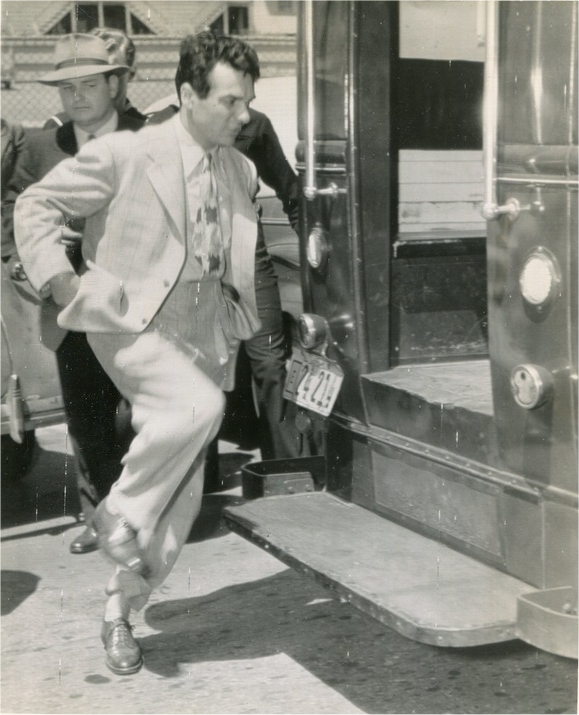
| Gene Krupa being arrested. |
Reefer Madness Jazz Musician Gene Kruba was
arrested in San Francisco on January 21, 1943 for contributing to the delinquency
of a minor when Law Enforcement Agents intercepted the 17 year old sent back to
Gene's hotel to retrieve his marijuana cigarettes as he was returning to the theater.
Gene Kruba's account of his arrest:
"By then I was the glamour boy-15 camel hair coats, three trunks around me
all the time-and he couldn't think what to get me. Finally he thought, 'Gee
I'll get Gene some grass.' At that time California was hot as a pistol, you could park your car for a bottle
of beer and get arrested. So he had a rough time getting the stuff. He probably
shot his mouth off a little-'I'm getting this for the greatest guy in the
world, Gene Krupa.' Gene decided to leave the marijuana at his hotel. The
police, being tipped off, began searching the theater where Gene's band was
currently playing. "I suddenly remembered the stuff's at the hotel where
they're going next. So I call up my new valet and say, 'Send my laundry out. In
one of my coats you'll find some cigarettes. Throw them down the toilet.' But
the kid puts them in his pocket and the police nail him on the way out, so I
get arrested." "The ridiculous thing was that I was such a boozer I
never thought about grass. I'd take grass, and it would put me to sleep. I was
an out-and-out lush. Oh, sure, I was mad. But how long can you stay mad? So
long you break out in rashes? Besides, the shock of the whole thing probably
helped me. I might have gone to much worse things. It brought me back to
religion."
During this time, Jazz was all the rage in San Francisco's Fillmore District where clubs lined the streets jazz beats lingering in the foggy night air. During the 40's and 50's Fillmore became known as the "Harlem of the West" attracting the same musicians who frequented the clubs of New York.
Some of the early clubs include The New Orleans
Swing Club, Club Alabama, Jackson's Nook and The California Theater Club. Bop
City, the most popular of the neighborhood venues, opens in 1950. The area has since been revitalized, museums holding remnants of the area's deep African American Jazz Culture. Clubs remain open to this day and the area serves as a tourist spot for San Francisco attracting millions of visitors annually.
Subscribe to:
Posts (Atom)